

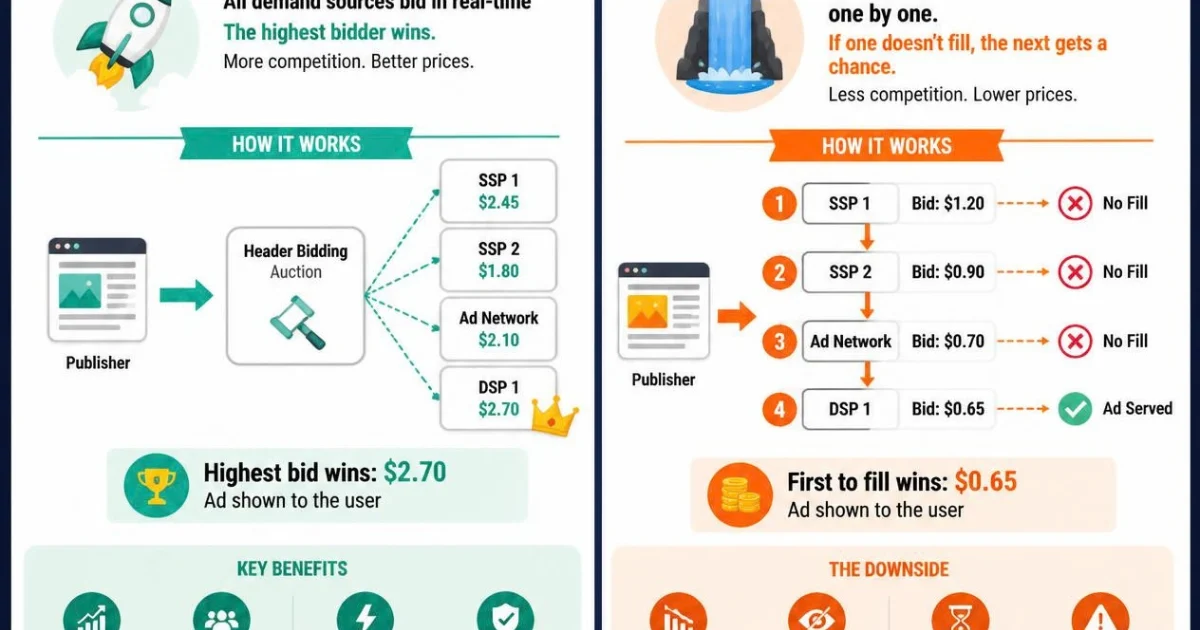
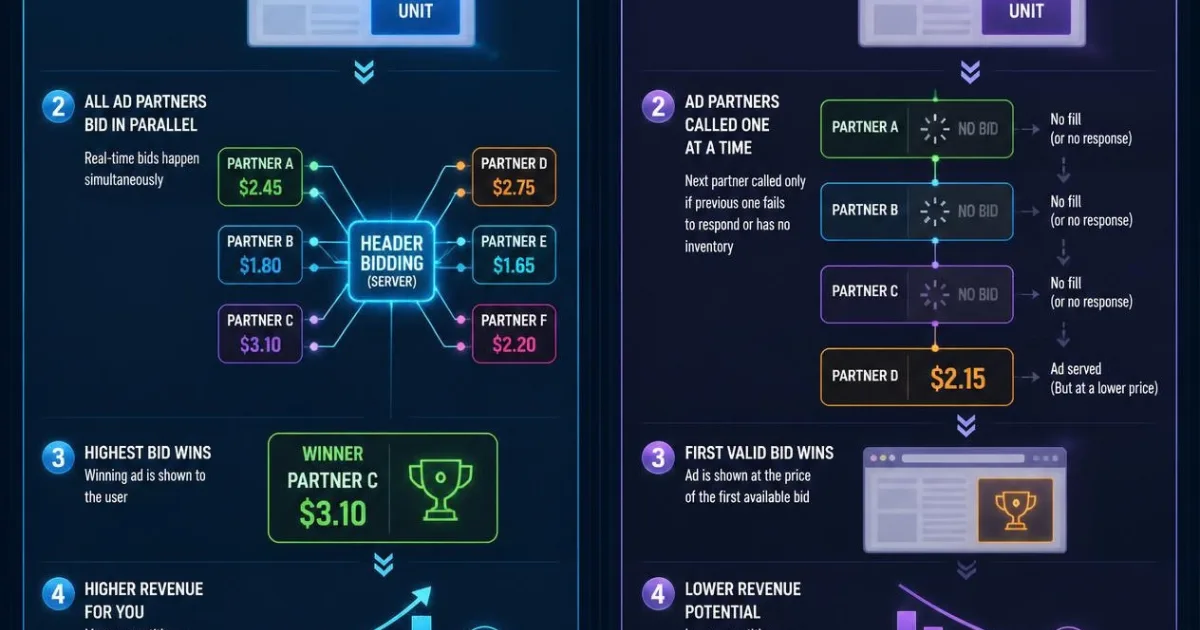
A waterfall ranks demand sources sequentially. If the first source does not fill or accept the opportunity, the next source is tried. Header bidding allows several approved demand partners to compete in parallel or near-parallel within a controlled timeout. Eligible results can then be compared or passed into the publisher’s broader ad-serving decision.
Key takeaways
- • Waterfalls call demand in a sequence; header bidding can expose an opportunity to multiple eligible bidders in the same decision window.
- • More bidders do not automatically improve revenue because latency, duplication and weak demand can offset auction pressure.
- • Publishers should evaluate net revenue, response time, timeout rate and page experience together.
- • Direct and guaranteed demand can still coexist with header bidding when priority is configured intentionally.
How a traditional waterfall works
A waterfall orders demand paths according to a priority model.
Historically, a publisher might put a premium network first because it had the highest average CPM. If that network did not fill the impression, the request moved to the next network, then to another, and so on.
The problem is that the ordering is usually based on expected or historical value rather than the exact value of the current impression. A partner that normally pays a high CPM may not want a particular impression, while a lower-priority partner might be willing to pay more for it. In a strict sequential waterfall, the lower partner may never get a chance if an earlier partner accepts first.
Waterfalls can also create chained latency. If each partner gets time to respond before the next is called, the total delay can grow. Publishers often tried to reduce that delay with timeouts and price tiers, but the architecture remained fundamentally sequential.
That does not mean waterfalls are useless. They can still be appropriate for certain direct, guaranteed, fallback, or operationally simple paths. The problem arises when sequential priority is used as a substitute for real competition across many programmatic buyers.
How header bidding works
Header bidding changes the order of demand competition.
Instead of waiting for one demand source to fail before calling another, the publisher can ask several eligible partners for bids within the same auction window. A client-side wrapper such as Prebid.js can coordinate those requests in the browser. A server-side architecture can move more bidder fan-out away from the browser.
The responses are collected until the configured timeout. Eligible bids can then be compared or represented as key-values in the ad server. The primary ad server still applies its own campaign priority, direct deals, guaranteed campaigns, and other rules.
Header bidding therefore does not necessarily replace the ad server. It adds a competitive demand layer before or alongside the ad-server decision.
The publisher gains a more current view of demand, but it also takes on more responsibility. Bidder timeouts, adapters, floors, currency, identity, consent, creative policy, analytics, and discrepancy monitoring all matter.
Header bidding vs waterfall: side-by-side
|
Area |
Waterfall |
Header bidding |
|
Demand order |
Sequential |
Parallel or near-parallel |
|
Price discovery |
Based partly on priority tiers |
More direct bid competition |
|
Latency pattern |
Can accumulate across sequential calls |
Can increase through fan-out and slow bidders |
|
Operational complexity |
Lower |
Higher |
|
Bid transparency |
Often limited to the called partner |
Multiple bid responses can be observed |
|
Incremental demand analysis |
Harder when partners are chained |
Easier to compare bidders, but duplication still exists |
|
Browser impact |
Depends on implementation |
Can be significant client-side |
|
Server infrastructure |
Often simpler |
Can be more complex server-side |
|
Best use |
Controlled or simple demand ordering |
Competitive programmatic demand |
A publisher can also combine both approaches. Direct campaigns may retain priority while header bidding competes among programmatic partners. Fallback demand may still be sequential.
Why header bidding became popular
The main appeal of header bidding is competition.
Under a waterfall, a partner near the top can win because of position rather than because it offers the best current price. Header bidding gives several buyers a chance to express their value for the same impression before the final decision.
This can improve price discovery. A niche buyer may value a technology article highly even if its historical average CPM is lower than another network. A regional advertiser may strongly value a specific geography. A video or rich-media buyer may value a placement differently from standard display demand.
Header bidding can reveal those differences in real time.
Publishers also gain better observability. They can compare bid rates, response times, bid CPMs, win rates, and timeout behavior by partner. That makes it easier to identify partners that add incremental demand versus partners that simply duplicate buyers already available through other paths.
However, increased competition does not automatically equal increased net revenue. The architecture must be managed carefully.
The latency tradeoff
Latency is one of the most important header-bidding risks.
In client-side header bidding, each bidder can create network activity from the user’s browser. More bidders mean more DNS lookups, connections, requests, JavaScript execution, and response processing. Even if requests run in parallel, the slowest meaningful bidder can influence the timeout decision.
A very long timeout may increase bid participation but delay ad rendering. A very short timeout may protect page speed but exclude valuable demand.
The correct timeout is not a universal number. It depends on geography, network conditions, bidder performance, placement importance, device type, and the publisher’s tolerance for delay.
Publishers should measure:
· median and tail bidder response time;
· timeout rate;
· revenue contributed by slow responses;
· ad render delay;
· page performance;
· viewability;
· user engagement;
· revenue per session, not only CPM.
A bidder that occasionally submits high CPMs after the timeout may look attractive in logs but contribute nothing to actual revenue.
Client-side header bidding
Client-side header bidding runs bidder coordination in the browser.
The advantages include direct visibility into bidder behavior and, depending on the environment, stronger access to browser-side identity or storage signals. The publisher can see which adapters are called and how quickly they respond.
The disadvantages are page-side cost. Every bidder can increase browser work. Poorly written adapters can create errors. Too many partners can increase network congestion. Consent and identity syncs can add additional requests.
Client-side header bidding is therefore not simply “add as many bidders as possible.” The best bidder set is usually smaller and higher quality than an uncontrolled list.
Publishers should remove partners that do not add incremental revenue, frequently time out, or duplicate demand without enough benefit.
Server-side header bidding
Server-side header bidding moves more of the demand fan-out into a server environment.
The browser sends a request to a server-side auction service. That service communicates with configured demand partners and returns eligible results.
This can reduce browser request volume and make it operationally easier to connect more partners. It can also centralize logging, connection reuse, timeout management, and infrastructure controls.
But server-side bidding introduces different tradeoffs. Identity signals may differ from browser-side integrations. Server location matters. Network paths between the server and bidders matter. Reporting and cookie-sync behavior can change. The server itself becomes critical infrastructure.
A poorly located or overloaded server can be slower than an efficient client-side setup. Publishers should measure end-to-end performance rather than assuming “server-side equals fast.”
The dedicated article Client-Side vs Server-Side Header Bidding should own that deeper comparison.
Price discovery and floors
Header bidding can improve price discovery, but floors still influence competition.
A publisher can set minimum prices below which bids are not eligible. Floors can protect inventory from very low-value demand, but overly aggressive floors can reduce participation and fill.
The important point is that header bidding makes more demand visible before the final decision. That visibility can help publishers evaluate whether floors are blocking legitimate competition.
For example, if several bidders consistently submit values just below a floor and the impression often goes unfilled, the publisher may be sacrificing revenue. On the other hand, lowering the floor too far may increase low-value fill without improving total revenue.
Publishers should analyze floor performance by placement, device, geography, format, and demand source. One global floor rarely reflects the value of every impression equally.
Bidder duplication
One of the biggest mistakes in header bidding is confusing “more bidders” with “more unique demand.”
Several SSPs or networks can reach the same DSPs. If a publisher adds all of them, the same underlying buyer may see the same impression through multiple paths.
That creates duplication. It can increase request volume, auction complexity, and fees without creating meaningful new demand. It can also make supply-path optimization harder for advertisers.
Publishers should ask each partner what demand is truly incremental. They should compare unique buyer access, net revenue contribution, and overlap.
A bidder that generates revenue is not automatically incremental. It may simply shift revenue from another path.
This is why header bidding should be managed as a portfolio of demand relationships, not a checklist of adapters.
Header bidding and Google Ad Manager
Many publishers use header bidding with Google Ad Manager.
The header-bidding layer collects bids and can pass eligible values into GAM through key-values or other supported integration methods. GAM then compares that programmatic demand with direct campaigns, guaranteed priorities, and other configured line items.
This means the header auction may not be the final decision. It is one input into the broader ad-server logic.
Publishers must therefore understand both systems. If key-values are mapped incorrectly, bid granularity is wrong, line items are missing, or targeting does not match, valid header bids may fail to compete properly.
Reporting also needs reconciliation between the header-bidding system and GAM. Differences in impression counting, time zones, currency, refresh behavior, and event definitions can create discrepancies.
The Google Ad Manager page should own broad integration intent, while this article focuses on the waterfall comparison.
Waterfalls still have valid uses
Header bidding did not make every form of sequential priority obsolete.
Guaranteed campaigns may need contractual priority. House ads may be used as fallback. A publisher may have sponsorships or direct relationships that should be checked before open programmatic demand. Some video or app environments may use mediation architectures that resemble waterfalls for operational reasons.
The key is intentional design.
A waterfall is problematic when a publisher assumes historical priority always represents current value. It is less problematic when the sequence reflects real business obligations or fallback logic.
A modern stack can therefore combine guaranteed priority, header bidding, private deals, open exchange demand, and fallback in a single decision tree.
What publishers should measure
Header bidding should be judged on more than gross bid CPM.
Useful metrics include:
· bid request count;
· bid response rate;
· bid CPM distribution;
· timeout rate;
· bidder response time;
· win rate;
· net publisher revenue;
· eCPM;
· fill rate;
· viewability;
· ad render time;
· page performance;
· discrepancy between systems;
· revenue per pageview or session;
· incremental revenue by bidder.
A partner with high bid CPM but very low response rate may contribute less than a steady bidder with moderate prices. A bidder with strong gross revenue may become less attractive after fees or duplication are considered.
Publishers should also compare performance by placement. A bidder that performs well on desktop display may be weak on mobile or native inventory.
How to migrate from waterfall to header bidding
A careful migration starts with measurement.
First, document the current waterfall. Identify each demand source, priority, average CPM, fill, timeout, and net revenue.
Second, choose a small set of high-value partners for the initial header-bidding test. Do not move everything at once.
Third, define timeout, floors, currency, consent behavior, creative controls, and ad-server mapping.
Fourth, run controlled experiments. Compare revenue, latency, page performance, viewability, and user experience.
Fifth, remove non-incremental bidders. The goal is not to maximize the number of participants; it is to maximize sustainable value.
Sixth, keep direct and guaranteed obligations clear. Programmatic competition should not accidentally override contractual campaigns.
A good migration is reversible. Publishers should know how to return to the previous configuration if revenue or performance deteriorates.
Common mistakes
Adding too many bidders.
This increases complexity and browser or server work without guaranteeing incremental demand.
Using a long timeout because “more bids are better.”
Late bids can cost page performance and may not add enough revenue.
Optimizing only for CPM.
Revenue, fill, viewability, and user experience matter together.
Ignoring demand overlap.
Several partners may reach the same buyers.
Misconfiguring ad-server line items.
A technically correct header auction can still fail if the ad server does not recognize the bids properly.
Ignoring creative quality.
Higher auction competition is not valuable if creatives violate policy or damage user experience.
Comparing gross revenue instead of net value.
Fees and discrepancies can change the result.
How AdExchange.bd fits
AdExchange.bd should treat header bidding as one publisher monetization capability within a broader programmatic ads network and exchange ecosystem.
The Header Bidding page should own broad header-bidding and Prebid intent. The Publishers page should own commercial publisher monetization intent. This article owns the comparison query header bidding vs waterfall.
That separation prevents cannibalization while creating a useful internal-link path:
Publisher monetization → Header bidding → Header bidding vs waterfall → Client-side vs server-side → Fill-rate and yield optimization.
This is exactly the kind of cluster that can build topical authority without creating multiple pages that all try to rank for “what is header bidding.”
A publisher’s decision rule
Waterfalls and header bidding differ mainly in how demand gets a chance to compete.
A waterfall is sequential. Header bidding creates broader simultaneous competition.
Header bidding can improve price discovery and demand visibility, but it also creates more operational responsibility. Publishers need to manage latency, bidder overlap, floors, identity, consent, ad-server mapping, creative policy, and reporting.
The best architecture is not the newest one. It is the one that produces the strongest sustainable publisher outcome after revenue, performance, quality, and user experience are measured together.
Why the comparison is really about auction design
A waterfall vs header bidding comparison is ultimately about when demand gets the chance to compete. Header bidding benefits for publishers depend on incremental demand, response time and clean auction controls rather than bidder count alone. Publisher waterfall advertising can still serve simple or priority-driven paths, while header bidding price discovery can improve competition when the implementation keeps latency under control.